Marx Lane

Marx Playset Figures, Structures, and Accessories
Manufactured from 1951 to 1980
Depicting American History
in the 18th and 19th Centuries

Introduction and Table of Contents
Contents of this web site may not be reproduced or duplicated for use on the Internet or for commercial purposes without permission by Eric Johns.


As of April 10, I have added new sections about American Civil War and Revolutionary War playsets into the site.  Be assured, however, that it takes only one additional mouse click on the American Wild West entry below to get to the same old Wild West pages!  
Please let me know of any problems you find by e-mailing me at ericjohns@roadrunner.com.  This especially includes links that do not work and photos that are missing.  Thank you and enjoy!

This web site was created in late 2007, providing information about Marx wild west playset figures on a single web page.  It now consists of about 25 web pages, with information on figures, structures, terrain pieces, and small accessories from Marx Wild West, Civil War, and Revolutionary War playsets.  It also has indexes for Playset Magazine and PFPC magazine.  I will continue to update these pages as I obtain more information and photos.  If you have anything to add to these pages or suggestions to make them better, please e-mail me at ericjohns@roadrunner.com.  I will be glad to attribute contributions to you.  And if you have questions or comments, I am always glad to hear from you!


Main Table of Contents
Click on the category to move to the section.
This Page
Introduction
A Brief Look at Louis Marx and Louis Marx and Company, Inc.
General Information on Marx Playset Figures, Structures, and Accessories
     
Other Pages
The American Wild West
The American Civil War
The American Revolutionary War
Other Events of 18th and 19th Century America (not yet available)
Appendix I - Index to Playset Magazine
Appendix II - Index to Plastic Figure and Playset Collector Magazine
Appendix III - Colors Used for Marx Playset Figures
Links to other related web sites

Recent significant updates to this web site:

7-17-10        Photos of the miniature Border Battle Play Set -- featuring the Alamo -- have been added on Page 6 of the Wild West Section.  Thanks to Jamie Zervos, Ebay ID Themid-nitepickle!  Also please note Tom Liekens' paintings of toy soldiers in the section section below!  A few other less significant photos have been added and information updated here and there.  
Note: I had a senior e-mail moment recently and erased several messages by mistake.  I believe that one of these was from a fellow collector asking about the Comanche Pass and Prehistoric mountain pass pieces.  If that was your message, please write me again! 
7-8-10         A variety of information and photos have been added, as well as a few corrections made, far too many to itemize.  These are primarily in the new Civil War and Revolutionary War sections.  Very special thanks go out for this update to collectors Rob Colwell, Mark Hegeman, and Josh Petrie.  They provided a wealth of information and photos for the site.  As usual, please notify me of any errors I have made, as well as anything that you can add to the site.
6-1-10        After adding the Civil War and Revolutinary War pages almost two months ago, I have been taking a bit of a break.  However, I have received a few new figures during that time and have finally taken photos and added them to the site.  These include:  two cereal premium figures on Wild West Page 7, a few new 60mm figures on Civil War Page 2 (three courtesy of collector Larry Tomikel), the final figures in the basic 54mm groups on Revolutionary War Page 1, and one new (and rather impressive, I think) WOW British figure on Revolutionary War Page 2.  I also purchased one of the 6-inch Indians made at the Swansea factory and added the photo to Wild West Page 5; I think it (Pose 5) gives you a good picture of the great red color they used for those figures.
4-25-10     Added numerous photos to site, primarily in the Civil War and Revolutionary War sections.  Also added a few photos to the Wild West Pages 5 and 7.  Many thanks to you who continue to provide photos of items I do not have!

Marx and other toy soldier information, news, and comments:
I am somewhat proud to say that I have received e-mails from collectors all over the world regarding this web site.  I am happy to see that so many people are enjoying it and that it is helping many people in their collecting.  A few days ago, I received an e-mail from Tom Liekens, a well-known comtemporary painter in Belgium, who has created several paintings inspired by toy soldiers.  A copy of a painting that he e-mailed me is shown below.  To see more of his very interesting work, visit his web site at http://www.tomliekens.com/.  Look for his painting of toy soldier GIs, a work that clearly shows the horrors of war without disturbing the viewer with realistic blood and guts (which too often seems to override the real message in movies and television shows).  However, his work extends way beyond the toy soldier arena, and I encourage you to take a look at his web site.  You may be confused about some of the paintings, but I am sure some will hit home.


I had a senior e-mail moment recently and erased several messages by mistake.  I believe that one of these was from a fellow collector asking about the Comanche Pass and Prehistoric mountain pass pieces.  If that was your message, please write me again!


Sad to say I missed the Marx Convention this year.  Just too many things to do and too little money to spend.  My wife Vicki and I spent a week in nearby southern Utah instead, visiting the huge number of National Parks and Monuments, as well as many interesting local attractions.  Now (July 8) I am off to spend two weeks with my daughter and her family near Chicago.  While there, I hope to do a little general site maintenance, correcting typos, pictures that have gone astray, etc.  On the other hand, I plan to spend a lot of time at Starbucks, sipping tea and catching up on the baseball news!  

Great article on the Marx Alaska Playset in the latest issue of Playset Magazine.  I think it has pushed me over the line into adding the Eskimo figures and the Alaska accessories to this site.  They were, after all, American natives also.  I already bought a few Eskimos from John Spargo, but if anyone can offer me a good deal on the figures or accessories, drop me an e-mail.  Oh, and the issue includes a very much needed article on Tim-Mee, with a promised sequel in the next (or at least future) issue.  I'm a big fan of the colorful Tim-Mee figures...they are a whole lot cheaper than Marx!  

The sad news (for me) is that I did not make the Texas Show this year.  I hear it was super!

I finally made it to the Indianapolis Toy Soldier Show this year (on April 18) and, as promised by fellow collectors, found it to be a great show for plastics collectors.  There was a good deal of metal also, but the percentage of plastics was much higher than other shows I have been to.  As far as Marx, I found a wide assortment of playset items available, ranging from 50 cent commons to $300-plus Custers.  Lots of tin litho -- including an Alaskan town front and a Revolutionary War cabin (with re-issue chimney) -- and lots of playsets.  My thanks to all the sellers who treated me so kindly!


Introduction


For Marx purists, the hobby of collecting Marx playset "toy soldiers" can be expensive, time-consuming, complicated, and frustrating.  On the other hand, it need not be for you.  With a few dollars and an occasional few hours, you can have a lot of fun in this hobby.  Marx playset figures and accessories are plentiful on Ebay and similar Internet sites, not to mention the many toy soldier shows held almost every week somewhere in the U. S., not to mention the rest of the world.  Some Marx playset items are very expensive, but many cost only a dollar or two.  In addition, generally-less-expensive reproductions of many items are available from current manufacturers, as are publications that provide a great amount of information on the playsets.

This web site is my attempt to provide a variety of information that I wish had been readily available to me when I began seriously collecting toy soldiers in 2002.  At that time, I knew nothing about Marx playsets other than 1) I owned and enjoyed several of them when I was a kid and 2) I had seen several pieces from old playsets on Ebay auctions.  It took me three or four years to figure out the bulk of information on this web site, and I am learning more and more almost every day.  

Many people are surprised to learn that Marx made quite literally hundreds of different playsets.  Because I am not yet rich enough to buy more than a few complete Marx playsets, this web site (and my collecting) concentrates on figures and accessories, not on complete playsets.  This makes sense, because for the most part, Marx made playset items in groups, such as cowboys, Indians, horses, cabin furniture, town furniture, horses, etc.  They then used these groups of figures or accessories in more than one playset, sometimes in dozens.  So collecting entire playsets might make you feel good, but it also will give you a lot of duplication.  I explain more about these groups later on this page.


I have attempted to make this site as complete and accurate as possible.  However, I cannot guarantee that all my information is totally accurate or that I am aware of all figures that exist.  I welcome any information that might add to or correct information on this web site.

For the most part, the information on this web page is not original.  I have drawn on numerous sources to obtain the information.  These include issues of the former magazine "Plastic Figure and Playset Collector" (PFPC) edited by Tom Terry, "Playset Magazine" (PM) edited by Rusty and Kathy Kern, Great Britain's "Plastic Warrior" magazine (PW) edited by Paul Morehead, the Guide for Non-Metallic Toy Soldiers of the U.S. by Tim Geppert, Richard O'Brien's book Collecting American-Made Toy Soldiers, Jay Horowitz' book The Authorized Guide to Marx Western Playsets, and Rusty Kern's recently-published book The Toy Kings.  I have also received voluminous information through discussions and correspondence with many toy soldier collectors, including many veteran collectors who I consider to be toy soldier experts.  S
ome of these persons have web sites that have given me much information and many points to ponder.

A special thanks goes to Kent Sprecher for providing me information on most of the molds used to make the playset items, as well as for the incredible amount of information on his exceptional web site.  Among the many collectors whose photos you will see on this web site, the most prolific donors include Mark Hegeman, Rick Koch, David Schafer, Josh Petrie, and Max Epifantsev.

My name is Eric Johns, and I am fully responsible for this web site, for better or worse.  
Please contact me if you find errors on this web page, have photos to share which are not included here, or have information that might be appropriate to add.  My e-mail is ericjohns@roadrunner.com and my telephone is 714-996-6229.  I will be glad to attribute contributions to you.  And if you have questions or comments, I am always glad to hear from you!

Go to top of page


A Brief Look at Louis Marx and Louis Marx & Co., Inc.

Louis Marx started his toy company in 1921 -- coincidentally the same year my father was born -- with his brother David, using equipment purchased from his former employer, the Ferdinand Strauss Toy Company.  The company grew through the 1940s, with the bulk of its sales being mass-produced tin lithograhed toys.

In the late 1940s and early 1950s, Marx and other toy companies introduced toy playsets that included figures, buildings, and related accessories such as animals, trees, wagons, and furniture.  
Each playset was created around a theme, such as a farm, an airport, a gas station, or a military base.  One of the earliest and most popular themes was the American wild west; Civil War sets were introduced later and also were big sellers.  The popularity of these playsets among children resulted in a "Golden Era of Playsets" that continued into the 1970s.

The figures and most accessories for these playsets were manufactured with new injection molding techniques developed during World War II.  A sculptor created a figure, and that figure was used to create a metal mold. Hot vinyl or plastic was then poured into the mold and allowed to cool, resulting in a playset figure that looked exactly like the original figure.  Marx commonly used large molds that held 10, 20, 30, or more individual figure molds.  

Figures in the earliest playsets were crudely sculpted with little detail and molded in rubber-like vinyl.  Within a few years, sculpting became what I would call an art form, and Marx changed to a soft plastic material.  These improvements allowed much more realistic figures.  Buildings were generally made of pressed steel and lithographed with appropriate designs (commonly called "tin litho" by collectors), and smaller accessories were molded usually in hard plastic, but sometimes soft.

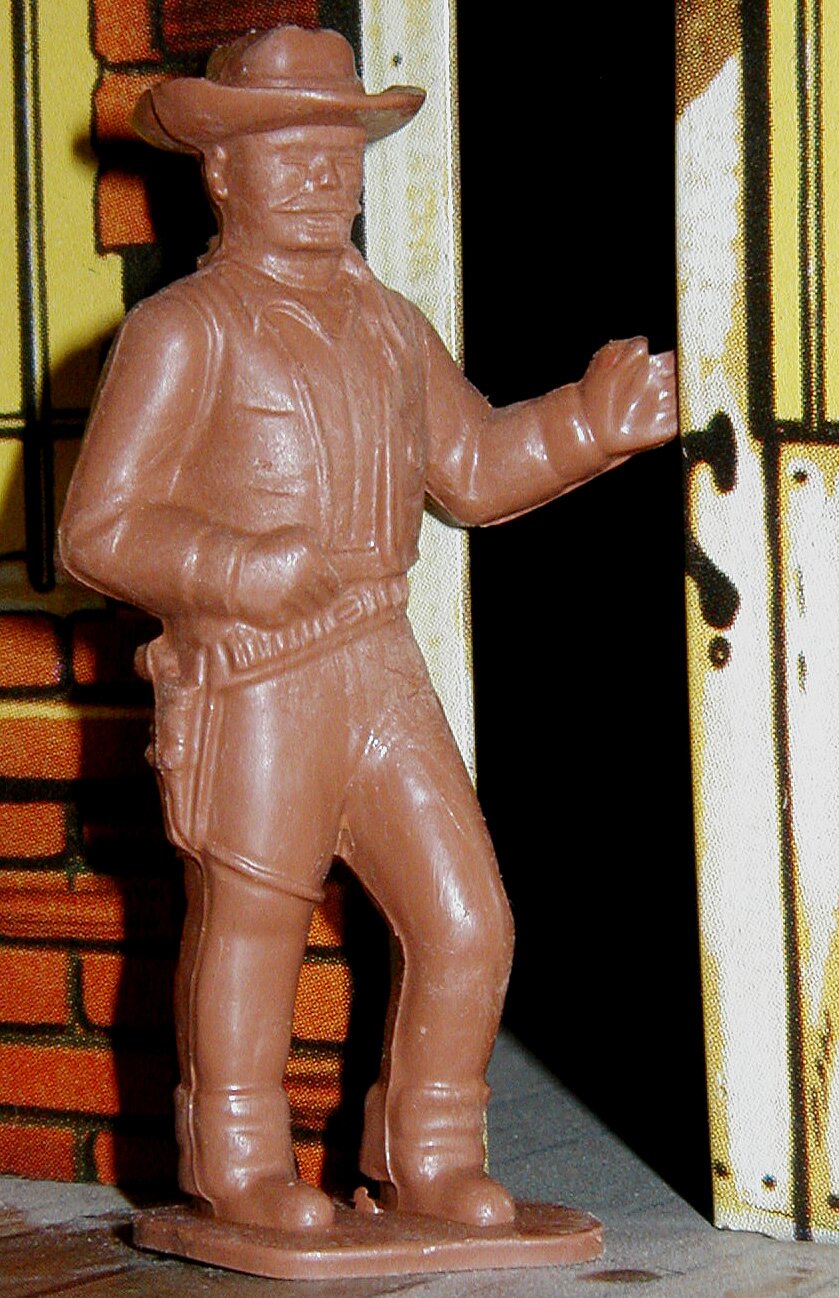
Figures in playsets were not painted; they were the color of the material used to produce them.  Marx mixed the material into many shades of yellow, brown, blue, red, gray, and other colors, including an often-used off-white that Marx referred to as ivory.  Marx did sell some similar figures -- or in some cases the same figures -- that were painted, but these were not included in playsets, with a handful of exceptions.

With the playsets as their backbone, the Marx Toy Company became the largest toy company in the world by the 1950s.  Mr. Marx maintained his offices in New York City, but the company's factories were located in both the U.S. and overseas.  He became known as "The Toy King," appeared on the cover of "Time Magazine," and was a close friend of President Dwight Eisenhower.

Mr. Marx sold the company to the Quaker Oats Company in 1972.  Unfortunately, many key Marx employees left the company at that same time, and Quaker Oats was unable to maintain Marx' extraordinary toy empire.  In 1975, the company was sold to Sir Richard Beecham of the toy conglomerate Dunbee-Combex of England, which ultimately filed for bankruptcy in 1980.  Liquidation of the remaining Marx Toy Company assets began in 1980 and was completed by Chemical Bank, the company's primary creditor, two years later.  Marx toy assets were purchased by Jay Horowitz and his company, American Plastic Equipment, Inc.  Subsequently, most playset and action figure prototypes were sold to Chuck Saults (several thousands), while a smaller amount went to Gene Scala (a few hundred).  Mr. Saults has since passed away, and his incredible collection was auctioned off on eBay over a period of more than a year.

Since that time, many people -- including Mr. Marx' son -- have used some of the old Marx molds to manufacture figures.  However, these re-issued figures are usually (but not always) easily distinguishable from the original figures, and collectors are quick to point out that they do not meet the quality of original Marx figures.
 
Mr. Marx died in 1982 at age 85.

The Authorized Guide to Marx Western Playsets by Jay Horowitz contains excellent chapters on the life of Mr. Marx and on the evolution of Louis Marx & Co, Inc.  Similar information, much of it based on interviews with former Marx employees, is included the book "The Toy Kings" and in a series of "Inside Marx" articles which appeared in "Plastic Figure and Playset Collector" magazine.  Both were written by Playset Magazine editor Rusty Kxxxx.

Go to top of page


General Information on Marx Playset Figures, Structures, and Accessories

During the 1950s, 1960s, and early 1970s, Marx manufactured hundreds of playsets.  Each set was centered around a central theme, ranging from Prehistoric Times to Medieval Times to the Wild West to Disneyland.  Other toy companies also produced playsets, but Marx made and sold far more than any other company.  Why?  Simply because their sets were almost always of higher quality and sold for equal or less money.

Figure and accessory groups
On this web site, most Marx figures and many accessories are divided into groups, which make up the figures that were produced in one Marx mold.  Wherever possible, groups on this web site are identified by "PL" numbers.  This number is the company's designation for the mold that was used to manufacture those figures.  As an example, you will see the company's Alamo figures designated as mold number PL-745.  Occasionally, Marx labeled related molds or revised molds as A and B.  For example, there were two groups of Civil War small accessories, designated as PL-909A and PL-909B.  

Note that, elsewhere, you will sometimes see mold numbers with an additional number added, such as PL-745-10.  The 10 indicates that the mold held 10 figures (including sometimes more than one copy of the same pose) or -- if in a list of playset contents -- may indicate the number of figures included in the playset from that mold.  
For the most part, I have tried to present the mold groups in the order that they were first produced and sold.
     

As already explained, most groups were included in more than one Marx playset.  By reusing the same expensive mold for several playsets, Marx kept its manufacturing costs down and thrived in the world of toy soldiers.  For example, Marx took its Fort Apache, added a couple of character figures, made its frontiersmen and Indian figures in a different color, revised the cabin into a U.S. Cavalry building, left everything else pretty much the same -- and suddenly it had a brand new Rin Tin Tin at Fort Apache Playset.  Or take its Revolutionary War set, add character from the Johnny Tremain television show -- and it had a Johnny Tremain Playset.  Some sets are differentiated only by having two of each figure instead of one, or three wagons instead of two; others have completely different figures, buildings, and other accessories.  The long-running Fort Apache playset was actually dozens of playsets, with changes being made in the set almost every year.  

Scales and sizes
Marx produced playset figures in several different sizes; information on this web site indicates the generally-accepted scale for each group of figures.  The most common scales that collectors use to identify figures are 45mm, 54mm, and 60mm.  These numbers represent the approximate scale height of a 6-foot tall person.  Thus, in 45mm scale, this person would be about 1-3/4 inches tall, in 54mm scale 2-1/8 inches tall, and in 60mm scale 2-3/8 inches.  Today, the 54mm scale is perhaps the most popular among collectors and is often referred to as 1/32 scale, a common scale for currently produced plastic toy soldiers.
These figures are 45mm, 54mm, and 60mm tall, not counting their bases.  Marx produced playset figures in all three scales.  In a few instances, Marx even included all three scales in one playset, though they clearly do not look right when used together.

While those are the most common scales for Marx figures, the company also produced playset figures as small as HO-scale (about an inch tall) and as large as 6-inch.  I've also included a few 8-inch figures on this site, though no playsets were ever issued in this scale.  Collector interest is decidedly less for items larger than the 60mm scale.  Marx did make toy figures that were larger -- such as their 11- or 12-inch figures -- but these are more nearly dolls with changeable clothing.  They are commonly called action figures and are not addressed in this web site, though they are collected by many people today.  

Interestingly, according to former Marx employees, the company did not use these scales which collectors have assigned to the figures, but rather saw the figures simply as large or small.  Despite that, sculptors of the figures and accessories must have used some scale measurements to ensure that items appeared reasonably sized when placed side-by-side, which has allowed collectors to assign the approximate scales to the groups.  On the other hand, if you look carefully at figures, you will find a few figures that appear too large or small for their group, and you will see that the actual size of Marx figures generally grouped into a 4- and 5-inch scale varies significantly.

I will admit up front that I have not sized the photographs on this web site so that the items are in proportion to one another.  I hope to improve that later.  Currently, the items in each group are shown in correct proportion to others in the group.  Of course, I have provided the accepted scale for each group of figures to give you a rough idea of the size, and I have often provided measurements for accessories.  In addition, I have taken photos of most figures immediately in front of common Marx Wild West split log or Civil War fences.

Materials used for playset items
The company used one of two materials to produce most of its playset figures.  vinyl in the early 1950s and of soft plastic starting in the mid-1950s.  To determine whether a figure is vinyl or soft plastic, place it in a bowl of water.  If it sinks, it is vinyl; if it floats it is plastic.  In addition, vinyl has a distintive smell.  Place a figure that you know is vinyl near your nose and you will see what I mean.  It's not a pleasant smell, but for those of us who had vinyl figures as children, it's a familiar and memory-jogging odor.  

Marx used hard plastic for many of its playset accessories such as furniture and trees, but did not use hard plastic for playset figures, except for
a very few which are pointed out in the narrative.  With one exception, none of these hard plastic figures were included in a traditional Marx playset with 45mm, 54mm, or 60mm figures.  For the most part, playset figures that you find made of hard plastic -- including those made using Marx molds after the company went bankrupt -- are not original Marx figures, but rather were made after Marx went out of business.  

Of course, there are degrees of soft and hard.  I do not understand the chemistry of plastic, but I know that Marx' early soft plastic figures are more soft than those made later.  And some hard plastic is less hard than other hard plastic.  Personally, I find it sometimes very difficult or even impossible to tell the difference between the more hard soft plastic of original Marx figures and the more soft hard plastic of some post-Marx figures.  If you feel confused, welcome to the world of collecting Marx figures.

While many accessories were made in hard plastic, some were soft plastic.  Some were produced both ways; for example, the common "A" tree used in playsets came both ways.  As already noted, most Marx buildings were produced in a thin pressed steel -- called "tin litho" by collectors.  These buildings were brightly decorated on the outside -- and often the inside -- with lithographed details.  

Marx colors
Marx used a wide variety of colors for its wild west figures.  And for each color, figures exist in a number of shades, such as powder blue, royal blue, and metallic blue.  I often find it very difficult to pick up a figure and state what color and shade it is, and sometimes am uncertain even what color it is.  This may sound odd, but I know that some other collectors experience the same problem.  Placing a figure side-by-side with a figure of another color sometimes helps.  But I would go so far as to say that at this point in my collecting, I am befuddled in my frustrating attempt to understand Marx' use of colors.  And that is what helps make collecting toy soldiers so fun!

To the best of my knowledge, the basic colors used by Marx for wild west figures were ivory (called cream by collectors today), brown, tan, yellow, gray, silver, blue, green, and red.  In a few cases -- but not often -- Marx tried out odd colors, such as frontiersman figures made in a fuzzy green color for its Fort Comanche playset and a bright orange for the Indians in a late Fort Apache playset.  While I refer to those green frontiersmen as fuzzy because the color tends to hide the figure details, Marx simply called them green, some collectors call them pea green, and others call them lime green.  This name game -- more than one name for the same color -- is another reason that I remain confused.  Figures used in many different playsets were often manufactured in many different colors, though only in one or two colors per group of figures for each playset.  Others that were not manufactured in such great numbers -- such as "character figures" of actual persons or recognized fictional characters -- were only made in one or two colors.  Almost all of the "character figures" (i.e., Roy Rogers, the Lone Ranger, Wyatt Earp, etc.) were produced almost exclusively in cream.

Civil War figures were, of course, made in blue and gray, but you will find them in lighter and darker shades of these colors.  Similarly, Revolutinary War figures were blue and red.

An important point on colors is that figures Marx produced late in its existence tended to take on a waxy look.  Many plastic figures produced today look this same way.  Generally, such figures are not as attractive as the earlier-made figures, largely because the waxy color tends to hide the figure details.  My understanding is that this is caused by the removal of lead content from the plastic.  Figures in these waxy colors are often avoided by collectors and usually cost less, sometimes much less.

Accessories were not created in such a variety of colors, though Marx did occasionally surprise with items such as the golden Revolutionary War cannon and "marbled" plastic rocks and hills.  Accessories were made almost always in brown, tan, black, gray, silver, or an ugly flesh color.

I have attempted to provide a more detailed display of Marx colors in Appendix III.

Buying Marx playset items
The market for Marx playset items is very much a "Buyer beware" market.  This is true for several reasons, especially if you are buying sight unseen.  First of all, of course, there are people out there who simply are not honest.  But it is more than that.  Some people selling "toy soldiers" simply are not familiar with them, so may not properly describe them.  For example, a figure that appears to be in good shape to a non-collector may be completely missing something that he is supposed to be holding in his hand.  Or a figure a non-collector whose friend told him that it was made by Marx, may have been made by a different company or have been made from a Marx mold years after Marx went bankrupt.  I have seen many Ebay auction titles that state Marx, where the description changes this to "I think it was made by Marx" or "This is an authentic reproduction made from the original Marx mold"  or even "This figure is compatable with Marx figures."

If you want to collect, you need to become as knowledgeable as possible about the playsets.  Don't get me wrong.  There are lots of honest dealers and nice people out there selling great Marx stuff...but buyer beware.

You must remember that many Marx figures have been re-issued or copied.  A re-issue (or recast or repro) figure is one that has been made from the same mold that Marx used to make the original figure.  Many original molds have been purchased or leased by many different companies in many different countries since Marx went bankrupt.  Hobby Bunker acquired a large inventory of them in 2007 and has been re-issuing many figures and accessories since then.  Classic Toy Soldiers (CTS) has re-issued several different groups of wild west figures for many years; Battlefield Legends and The Toy Soldier Company also sell a large variety of Marx re-issue items.  All of these companies are careful to point out that the items are re-issue.  I am seeing more and more re-issues coming from companies outside the U.S. also.  

For several years after Marx went bankrupt, there apparently were a large number of low quality re-issues being made.  Re-issues were strongly criticized by collectors, and most serious collectors continue to shun them.  Part of their concern is that re-issues will be made in virtually the same color as original items, so that it will be difficult to tell them apart.  This is a valid concern, because it unfortunately has happened.  However, I think it is important to note that since I came into the hobby in 2002, I have been surprised that many re-issue items are well made and are comparable in quality to the original Marx item.  Just because it's re-issue does not mean it is junk!  It's just not original.

Usually, companies have deleted the Marx logo on re-issues, replacing it with their own logo, the country of manufacture, or simply left the place for the logo blank.  Of course what makes all this even more complicated is that Marx sometimes manufactured items with no logo; no one said this hobby was easy!

A copy is a figure that has been made to look the same as a Marx figure, but has been manufacured using a mold created by someone other than The Marx Toy Company.  Even while Marx was in its heyday, competing companies such as MPC were creating figures based on the Marx figure poses, though with some experience it generally is not difficult to tell them apart.
The blue Indians above were made by MPC in the 1950s and 1960s, copies of the Marx Indians.  Though very similar, MPC changed a few details on the figures.  For example, look at the Indian chiefs' headdresses or the position of the spear in the figures at the right.

Often, original Marx figures are used to create a mold, which is then used to make copies.  If so, the copy will be slightly smaller than the Marx original figure, perhaps two or three millimeters.

Often -- but not always -- re-issues and copies are made in a hard plastic never used by Marx for its common playset figures.  Often -- but not always -- re-issues and copies are made in colors never used by Marx.  For example, if you have a wild west figure that is black, purple, or pink, it is not original Marx.  If it is hard plastic and a nice shiny color, it is not original Marx.  Some re-issues and copies are easy to spot; others are better made and are difficult to identify except by experienced collectors.  A few are so close to the originals that it is almost impossible for anyone to tell the difference between them and the Marx originals.  

You make the call:  Which ones are original and which ones are re-issue?
The silver and cream figures in the center are original.  The blue and green are re-issue.  Marx did make a very small number of 60mm cowboys in blue and green, sold in bags of figures rather than playsets.  But the colors were flatter and duller than the blue and green of the two figures above.  Cavalry and Civil War figures were in blue, but the figure above belongs to neither of those categories.  Despite the colors, note that these re-issues do show good detail.  Not all re-issues are so easily identified!

I believe it is best to assume that all of the playset items have been re-issued or copied and to be alert for such possibilities when purchasing figures.  I was surprised to see that Hobby Bunker has even re-issued the 6-inch scale chuck wagon accessory group, a scale that most collectors are not interested in and an item that -- in my opinion -- only the most serious collectors even know about.  Despite that, I am sure there are at least a few items that have not been re-issued; not only have I never seen any 60mm Western Ranch figures in re-issue, but I seriously doubt there would be any demand for the rather crude, inactive poses...not that us collectors don't love the originals.  On the other hand, their horses have been re-issued.....

A lesser issue to be aware of is that there are a number of "dump" figures out there.  These are figures that Marx discarded in a dump during the company's operation somewhere near its factory in Glendale, West Virginia.  In some cases -- or so I have heard -- they discarded entire production runs, even though only some of the figures were bad.  Unless identified as such, the only way I know to identify such items is that after being buried in these dumps for many years, they will be discolored, most usually gray.  If you see a Wyatt Earp figure (which was produced in cream) that is gray, it probably came from a dump site. Now...if a "dump" figure is in good shape, is it less valuable that a non-dump figure?  Will a "dump" figure deteriorate faster over time?   Or after years underground, has it become some sort of toxic waste material?  I have no idea, though I have owned a few and noticed no difference.   Just be aware that such figures exist.

All prices noted on this web site are for information purposes only and should not serve as a price guide.  The prices given are simply what I have observed, and I have not attempted to calculate any accurate average prices for figures.  I am sure that you will find the figures selling for more and for less than those prices I cite.  There are many factors that affect prices, including condition of a figure, color, the supposed number of figures available, the reputation of the seller, and how much the guy in Montana is willing to pay for exactly the same figure you want, which happens to be the only figure that he needs to complete his five-thousand dollar Marx play set.  

Of course, the sad fact is that it is common to pay more for a single figure today that it originally cost for an entire playset.  If you are new to the hobby, that's something you just have to get used to if you want to collect anything more than the most common, play-ravaged figure.  

Taking care of your figures and accessories
A few random rules to remember:
While you generally should clean the dirt off your figures (to see what color they really are!), dirt is not always a bad thing.  I have often hesitated or decided not to clean a figure because the small amount of grime on it enhances the color and adds depth to the figure.  Never under-estimate the power of dirt.  It is hard to explain this, so I can only use the old cliche and say, "You'll know it when you see it."  Take a look at the 5-inch stagecoach group on Page 4 for an example of such figures.  Of course, I often wash figures, and they usually look much better afterward.  I soak them a few hours in a 50-50 mix of water and 409, then gently scrub them with a soft or medium toothbrush.  Besides dirt, this method will remove most paints, though soaking might need to be longer.  Other collectors have other cleaning methods.  

My epilogue
Finally, a personal observation based on my collecting experience.  There are Marx figures...and then there are Marx figures.  You will see a figure that you deem excellent, and then you will see another figure in the same pose that just blows you away.  You will see a near mint figure that looks nice, and then see the same figure that clearly is not mint, but looks more attractive than the mint one.  

There are several reasons for this.  Color is an important one; some colors show off a figure's detail better than others.  Another reason is the material used for a particular figure, well-mixed plastic will show much better detail than vinyl or even (I would assume) "poorly-mixed" plastic.  Perhaps another is the expertise and care of the workers that participated in manufacturing a specific figure or group of figures; you can't blame a computer for those molding errors!  However, I believe a very key reason is that molds used in making figures wear down as they are used over and over.  As they do so, they are cleaned, washed, and repaired.  
I imagine that these processes extend the life of the mold, but cannot return it to its original pristine condition.  As a result, you will find some original Marx figures with fine, sharp details and other original Marx figures -- made later in the life of the mold -- that have slightly more blurred and softened details.

So there are some extremely fine examples of Marx playset figures out there that most likely were manufactured when a mold was still new, the color was right, and the batch of vinyl or plastic mixed well.  When you see these, you cannot help but say, "Wow!"  There are also figures in good condition on which the details are less vibrant; these cause you to perhaps say, "That's a nice figure" or "I have one of those already."  There is absolutely nothing wrong with that second category of figures, but just something that is wise to keep in mind.  Buy what you can afford, and ask for the ones you can't afford as Christmas gifts!  (And occasionally splurge just a little bit, but never forgetting "Buyer beware.")

For an excellent informative article on collecting Marx toys written in 2009, click here.

I hope you enjoy both this web site and hobby!  Feel free to drop a note to me with questions, comments, or just a simple hello anytime (ericjohns@roadrunner.com).

Go to top of page

Contents of this web site may not be reproduced or duplicated for use on the Internet or for commercial purposes without permission by Eric Johns.


Free Counters from SimpleCount.com
Web Counters